
Market dynamics for US paper currency demonstrate stable segmentation based on rarity markers.
The face value of a 5 dollar bill often fails to match its actual trading worth at auctions.
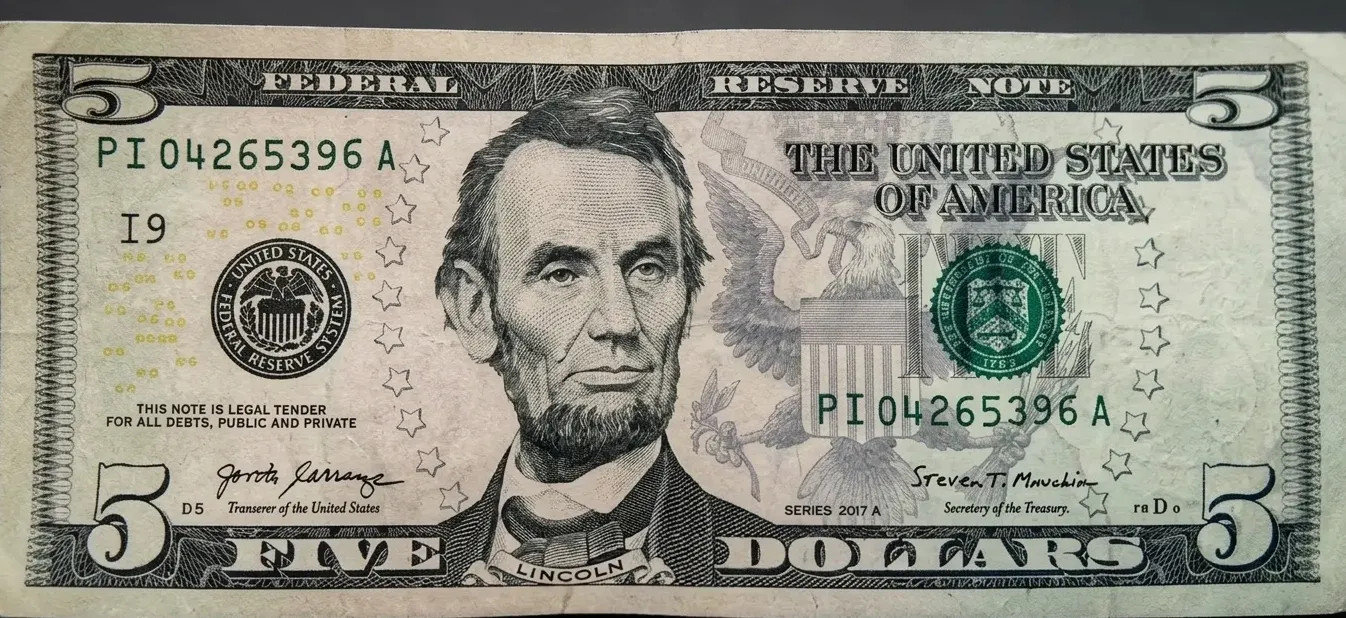
| Parameter | Specification |
| Weight | 1.00 grams |
| Length | 155.95 mm |
| Width | 66.29 mm |
| Thickness | 0.11 mm |
| Paper Composition | 75% cotton, 25% linen |
| Main Printing Method | Intaglio |
| Portrait | Abraham Lincoln |
| Back Image | Lincoln Memorial |
Classification of Valuable Serial Numbers
Serial numbers serve as primary identifiers of banknote uniqueness.
Standard combinations consist of eight digits and alphabetic indexes.
Mathematical probability of specific sequences appearing remains extremely low.
Listed below are number categories increasing the note value in 2026.
- Low numbers: sequences ranging from 00000001 to 00000100
- Radars: numbers reading identically from left to right and right to left
- Ladders: consecutive ascending or descending digits
- Solids: numbers consisting of eight identical digits
- Binaries: combinations including only two different digits
- Repeaters: blocks of digits duplicating within the number twice or more
Process for evaluating number rarity according to the 2026 scale:
- Identifying the combination type.
- Verifying number alignment with a specific release series.
- Cross-referencing recorded auction sales databases.
- Assigning a rarity coefficient.
Price Change Statistics for Rare Numbers 2021–2026
Price dynamics demonstrate a steady upward trend.
Market indicators show rising interest in mathematical anomalies within serial numbers.
| Number Type | Price Growth 2021-2023 | Price Growth 2024-2025 | Forecast for Late 2026 |
| Solid (88888888) | +12% | +15% | +18% |
| Low (00000001) | +8% | +11% | +14% |
| Radar | +4% | +6% | +7% |
| Replacement Star | +5% | +9% | +10% |
Impact of Preservation Condition on Value
Paper condition is determined using the international 70-point Sheldon scale.
A certifying organization assigns a numerical grade after detailed inspection.
Any mechanical impact reduces the final realization price.
Main defects and their influence on price:
- Center fold → 35% loss in value
- Corner creases → 15% loss in value
- Surface dirt → 20% loss in value
- Torn fragments → 80% loss in value
- Holes from bank staples → 40% loss in value
Correlation between grade and market multiplier:
| Grade on Sheldon Scale | Condition Description | Multiplier to Base Price |
| 70 | Perfect Uncirculated | 12.0x |
| 67 | Superb Gem Unc | 6.5x |
| 64 | Choice Uncirculated | 3.0x |
| 58 | About Uncirculated | 1.5x |
| 20 | Very Fine | 0.7x |
Record Auction Sales of US 5 Dollar Bills
Actual data from trading platforms confirms high liquidity for rare specimens.
Listed below are lots showing maximum results.
| Series | Rarity Type | PMG Rating | Sale Price |
| 1928 | Low Number 00000001 | 66 EPQ | $34,000.00 |
| 1995 | Error Print (Double) | 64 | $5,800.00 |
| 2006 | Solid 99999999 | 67 | $11,200.00 |
| 2013 | Star Note (Rare Run) | 68 | $1,450.00 |
| 1953 | Red Seal (Number 1) | 65 | $18,500.00 |
Star Notes and Their Identification
Star banknotes are printed to replace defective sheets during the production process and help you to check them with the best coin appraisal app.
A star symbol replaces the suffix letter at the end of the serial number.
The print run of each replacement series remains limited.
Rarity is determined by the volume of the printed batch.
Classification of star note print runs:
- Common: over 640,000 units per batch.
- Rare: from 100,000 to 640,000 units per batch.
- Exceptional: under 100,000 units per batch.
Small release volumes automatically correlate with high prices.
Five-dollar notes from the 2013 series with small star sheet runs show a 12% annual price increase.
Printing Errors as a Collection Factor
Production failures on the printing press create unique specimens.
The Bureau of Engraving and Printing attempts to destroy such banknotes, increasing the rarity of surviving samples.
Typology of sought-after errors:
- Image shift: design movement relative to sheet edges
- Insufficient ink supply: pale fragments of the portrait or seals
- Paper fold: printing on a creased sheet creating blank stripes after flattening
- Inverted printing: applying serial numbers or seals upside down
- Mismatched numbers: left and right serial numbers containing different digits
Price for a specimen with mismatched numbers from the 2009 series reaches $2,400.00 in 2026.
Standard banknotes of the same year cost exactly $5.00 for comparison.
Historical Evolution of the 5 Dollar Design
Changes in appearance reflect developments in security technologies.
Each new design type creates a separate direction for classification.
Brief chronological list:
- 1928–1950 Series: small format, classic design, high portrait detail.
- 1953–1963 Series: changing inscriptions and seals, introducing the In God We Trust motto.
- 1999 Series: enlarged Lincoln portrait, appearing security thread and microprinting.
- 2008 Series: implementing digital codes, purple shades, and watermarks.
Using devices for watermark verification allows distinguishing original banknotes from fakes.
Counterfeit specimens possess no numismatic value.
Mathematical Rarity Calculation of Serial Numbers
Probability of finding a rare combination in circulation remains very low.
Total quantity of possible eight-digit combinations equals 100,000,000 variants.
Probability distribution for popular types:
- Solid (all digits identical) → 1 in 11,111,111 banknotes
- Radar (palindrome) → 1 in 10,000 banknotes
- Binary number → 1 in 8,703 banknotes
- Low number (under 100) → 1 in 1,000,000 banknotes
High cost stems from the impossibility of mass discovery for such objects.
Professional Certification Procedure
Verification of authenticity and condition occurs in specialized laboratories or simply usage the coin appraisal app free.
Presence of a plastic holder stating characteristics is a mandatory condition for major deals.
Certification stages in 2026:
- Submitting the banknote to a representative of an expert organization.
- Instrumental analysis of paper and ink composition.
- Determining fiber wear levels under a microscope.
- Assigning a grade and unique number in the registry.
- Sealing in a capsule excluding contact with oxygen.
A certified note costs 45% more than a non-certified counterpart in equal visual condition.
Regional Issuance Features
Twelve Federal Reserve Banks issue their own series.
Alphabetic index in the serial number indicates a specific bank.
| Letter | Issuing City | Frequency of Occurrence |
| A | Boston | High |
| B | New York | Very High |
| C | Philadelphia | Medium |
| F | Atlanta | High |
| I | Minneapolis | Low |
| L | San Francisco | Medium |
Banknotes with the I index from Minneapolis often have smaller runs, creating local scarcity.
The price for such banknotes in Uncirculated condition stays 15% above the average market value.